
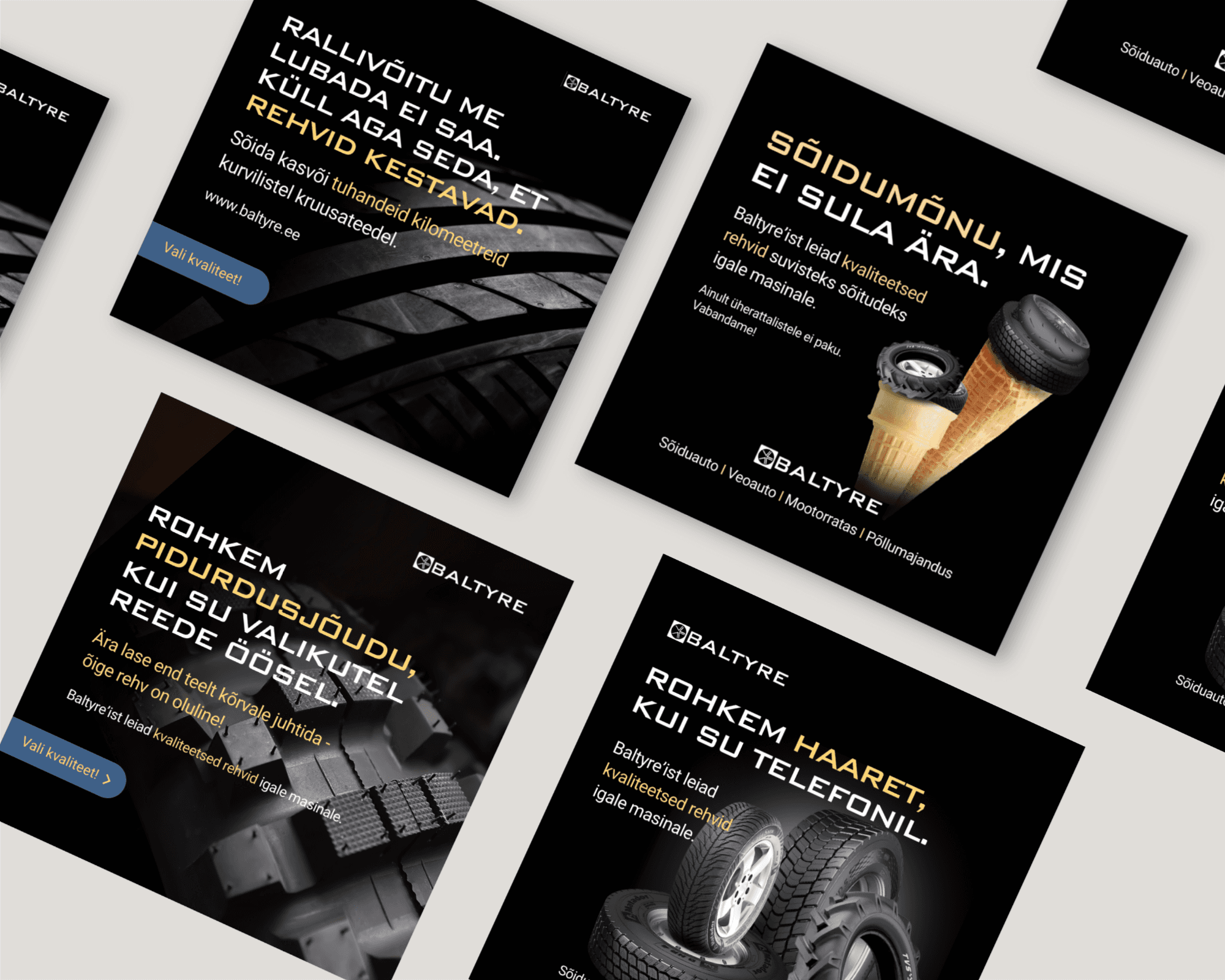
Tyres that leave a mark not only on the road, but also in the memory.
Media
Creative campaign
Media
Creative campaign
We addressed a strategic need: to breathe new life into a brand that would remain memorable even when it is not immediately needed. A brand strong enough to overcome the effects of seasonality and a long repeat purchase cycle.
Client
Baltyre Eesti AS
Sector
Ecommerce + B2B
Period
2025
While brands in general are able to communicate with consumers on a daily basis, a tyre retailer has only specific seasons and the opportunity to do so once every few years. This creates a situation in which the brand is easily forgotten and must essentially start from scratch with every season. In the midst of the season itself, visibility can be lost with ease.
Humour was not an arbitrary choice, but a deliberate psychological tool in the battle against seasonality and low purchase frequency. When a person buys tyres once every three years, the brand cannot afford to be forgotten in the intervening period. For this reason, we employed creativity not to capture attention, but to shape memory. Humour activates emotion and the dopamine system, which reinforces the associations stored in memory — this was a deliberate decision, not a casual choice of tone.
195%
Growth in retail client sales revenue, accompanied by a rise in B2B volumes as well
30%
More favourable CAC, meaning the cost of acquiring a single client decreased over time
60%
Growth in brand searches, at a time when competitors' search volumes were in decline
The specific objectives were as follows:
To grow retail client sales by at least +150% YoY (in previous years, spring retail client revenue was slightly below €10K per month, and in autumn slightly below €20K per month)
To increase the number of brand searches by at least 50%
To reduce CAC by at least 25% (compared YoY)
Process
Goals
Taking into account the specific characteristics of the category — thin margins, a long repeat purchase cycle, and a limited brand budget — the Baltyre brand had to be grown within performance channels. Every euro spent on marketing had to work doubly: delivering immediate sales while simultaneously building long-term brand preference.
Rather than a campaign-based approach, we designed a system in which each touchpoint increased the effectiveness of the next. Digital advertisements supported brand searches, searches grew organic traffic, and organic traffic reduced dependence on paid advertising. Marketing became a self-sustaining process that grew more cost-efficient and effective with each passing month.
In traditional tyre communication, price and technical specifications are sold. We reversed this and sold a mood instead. Humour was not merely a creative choice, but a deliberate memory mechanism. Psychologically, humour is the most effective memory anchor, and in a category where a purchase occurs once every three years, memory is an important sales channel. Testing revealed that humorous advertisements were remembered 42% more effectively.
The channel strategy was selected on the basis of impact, not volume. Meta and Google Ads drove sales and tested memory retention, Delfi and Postimees built trust, while out-of-home and print provided a physical presence. All channels were connected through a unified signal logic: if a person did not make a purchase, they were directed not to aggressive remarketing, but to a memory-warming stage.
In media, we applied four tactics: tonal consistency (a consistent voice and use of humour), micro-pulsing (small waves of messaging outside of the peak season), data-guided rotation (optimisation based on memory impact rather than CTR), and contextual presence (messages that responded to changes in weather and season).
For Baltyre, the memory effect was the benchmark for long-term brand capital, the true impact of which will become apparent over a period of 3 to 5 years. The first year, however, focused on early signals of memory retention.
We assessed impact through three parallel measurement systems:
The stability of search volume and direct traffic following the season indicates whether the brand remains in memory even after active marketing subsides. In the case of Baltyre, traffic declined by only 30% after the season, whereas the category average was 65–70%.
Based on Google Trends and Search Console data, we created a memory metric that assesses how quickly category interest recovers following the active period. Baltyre maintained a 2.8x higher level of interest than its nearest competitor.
Meta's "Estimated Ad Recall Lift" showed that humorous advertisements were remembered 42% more effectively. In addition, we employed an AI-based memory probability model, which analysed how long an advertisement remained within the organic attention sphere following exposure (e.g. engagement decay).
Let's get acquainted & achieve your goals together.
We are here to help businesses that want more. If you are ready for the next step forward — let's do it together.
Tyres that leave a mark not only on the road, but also in the memory.
Media
Creative campaign
We addressed a strategic need: to breathe new life into a brand that would remain memorable even when it is not immediately needed. A brand strong enough to overcome the effects of seasonality and a long repeat purchase cycle.
Client
Baltyre Eesti AS
Sector
Ecommerce + B2B
Period
2025
While brands in general are able to communicate with consumers on a daily basis, a tyre retailer has only specific seasons and the opportunity to do so once every few years. This creates a situation in which the brand is easily forgotten and must essentially start from scratch with every season. In the midst of the season itself, visibility can be lost with ease.
Humour was not an arbitrary choice, but a deliberate psychological tool in the battle against seasonality and low purchase frequency. When a person buys tyres once every three years, the brand cannot afford to be forgotten in the intervening period. For this reason, we employed creativity not to capture attention, but to shape memory. Humour activates emotion and the dopamine system, which reinforces the associations stored in memory — this was a deliberate decision, not a casual choice of tone.
195%
Growth in retail client sales revenue, accompanied by a rise in B2B volumes as well
30%
More favourable CAC, meaning the cost of acquiring a single client decreased over time
60%
Growth in brand searches, at a time when competitors' search volumes were in decline
Goals
The specific objectives were as follows:
To grow retail client sales by at least +150% YoY (in previous years, spring retail client revenue was slightly below €10K per month, and in autumn slightly below €20K per month)
To increase the number of brand searches by at least 50%
To reduce CAC by at least 25% (compared YoY)
Process
Taking into account the specific characteristics of the category — thin margins, a long repeat purchase cycle, and a limited brand budget — the Baltyre brand had to be grown within performance channels. Every euro spent on marketing had to work doubly: delivering immediate sales while simultaneously building long-term brand preference.
Rather than a campaign-based approach, we designed a system in which each touchpoint increased the effectiveness of the next. Digital advertisements supported brand searches, searches grew organic traffic, and organic traffic reduced dependence on paid advertising. Marketing became a self-sustaining process that grew more cost-efficient and effective with each passing month.
In traditional tyre communication, price and technical specifications are sold. We reversed this and sold a mood instead. Humour was not merely a creative choice, but a deliberate memory mechanism. Psychologically, humour is the most effective memory anchor, and in a category where a purchase occurs once every three years, memory is an important sales channel. Testing revealed that humorous advertisements were remembered 42% more effectively.
The channel strategy was selected on the basis of impact, not volume. Meta and Google Ads drove sales and tested memory retention, Delfi and Postimees built trust, while out-of-home and print provided a physical presence. All channels were connected through a unified signal logic: if a person did not make a purchase, they were directed not to aggressive remarketing, but to a memory-warming stage.
In media, we applied four tactics: tonal consistency (a consistent voice and use of humour), micro-pulsing (small waves of messaging outside of the peak season), data-guided rotation (optimisation based on memory impact rather than CTR), and contextual presence (messages that responded to changes in weather and season).
For Baltyre, the memory effect was the benchmark for long-term brand capital, the true impact of which will become apparent over a period of 3 to 5 years. The first year, however, focused on early signals of memory retention.
We assessed impact through three parallel measurement systems:
The stability of search volume and direct traffic following the season indicates whether the brand remains in memory even after active marketing subsides. In the case of Baltyre, traffic declined by only 30% after the season, whereas the category average was 65–70%.
Based on Google Trends and Search Console data, we created a memory metric that assesses how quickly category interest recovers following the active period. Baltyre maintained a 2.8x higher level of interest than its nearest competitor.
Meta's "Estimated Ad Recall Lift" showed that humorous advertisements were remembered 42% more effectively. In addition, we employed an AI-based memory probability model, which analysed how long an advertisement remained within the organic attention sphere following exposure (e.g. engagement decay).
Let's get acquainted & achieve your goals together.
We are here to help businesses that want more. If you are ready for the next step forward — let's do it together.